Lawmakers spar over Yoon's martial law, controversial insurrection remarks
Rival parties clashed Thursday over the decadelong delay in establishing a foundation tasked with addressing North Korean human rights abuses.
During a parliamentary audit of the National Human Rights Commission of Korea, lawmakers from the main opposition People Power Party criticized the Democratic Party of Korea for failing to nominate board members to the North Korean Human Rights Foundation, and thus preventing its launch.
The foundation mandated under the North Korean Human Rights Act, which took effect in 2016, is intended to support research, policy development and civil society activities aimed at improving human rights conditions in North Korea. Its establishment has been stalled by political disagreements over the appointment of its board members.
"The North Korean Human Rights Act is now in its 10th year of implementation, yet the North Korean Human Rights Foundation has still not been established," People Power Party Rep. Kim Mi-ae said during the National Assembly Steering Committee's audit.
Kim pointed out that the human rights commission had formally recommended that the Democratic Party's floor leader nominate five directors to the foundation, but the ruling party had yet to comply. Fellow People Power Party lawmaker Rep. Kim Ki-woong echoed the criticism, stressing that the legislation had originally been passed with bipartisan support.
"The North Korean Human Rights Act was passed through bipartisan agreement," Kim said. "Yet despite agreeing to enact the law, the Democratic Party has never once recommended board members."
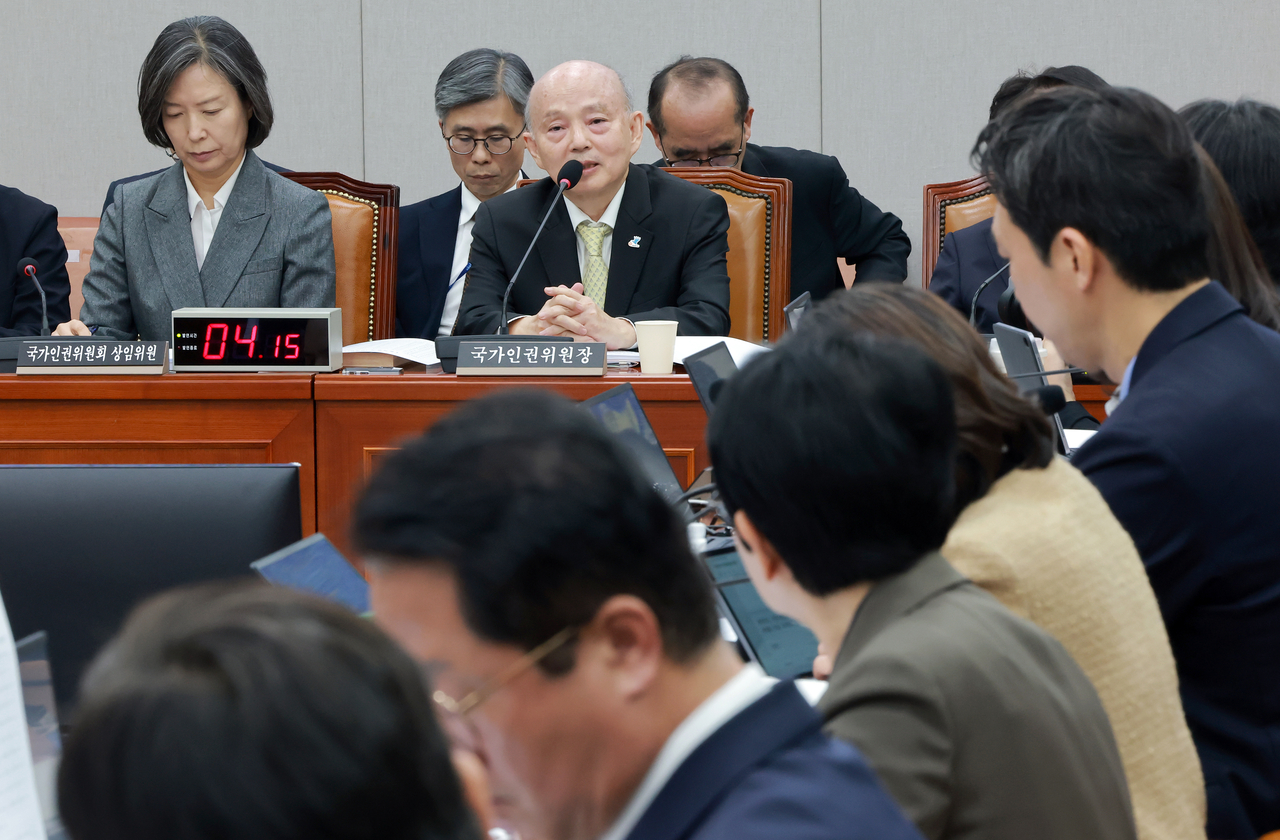
National Human Rights Commission Chair Ahn Chang-ho, who was also present at the audit, also called for greater cooperation from the political establishment to end the prolonged impasse.
"I hope that not only the government but also the National Assembly will actively cooperate in launching the North Korean Human Rights Foundation," Ahn said.
The foundation's continued absence has remained a contentious issue in South Korean politics, reflecting broader differences between the rival parties over how to approach North Korean human rights and relations with Pyongyang.
The People Power Party has repeatedly called for the law's full implementation, while the Democratic Party has faced criticism over its failure to nominate the required directors.
The audit also exposed deep partisan divisions over the human rights commission's handling of former President Yoon Suk Yeol's impeachment proceedings following his short-lived declaration of martial law in December 2024.
Democratic Party lawmakers pressed Ahn over the commission's controversial recommendation, adopted in February 2025, calling for Yoon's right to defense to be guaranteed during the proceedings.
Earlier this month, the commission voted to issue a public apology over the recommendation, but Ahn abstained from the vote and continued to defend his position.
"My position remains unchanged that due process must be upheld, regardless of what punishment a person may ultimately receive for the substance of their crimes," Ahn said.
Asked by Democratic Party lawmaker Rep. Park Jeong-hyeon whether Yoon was the ringleader of an insurrection, Ahn acknowledged that the martial law declaration had been unconstitutional but declined to make a definitive judgment on the criminal charge.
"The declaration of martial law was clearly wrong and unconstitutional," he said. "However, as to whether it constituted insurrection, I will await the Supreme Court's ruling and respect its judgment."
The hearing was further overshadowed by a heated confrontation over remarks by People Power Party Rep. Kim Tae-kyu, who previously denied that former Presidents Chun Doo-hwan and Yoon Suk Yeol had committed insurrection.
Kim made the remarks during a YouTube appearance on Sept. 30, prompting the Democratic Party to accuse him of distorting historical facts and demand his resignation from the Steering Committee. During the interview, when the host asked, "Was Yoon Suk Yeol's action an insurrection?" Kim replied, "No." Asked whether Chun Doo-hwan had committed insurrection, he responded, "It was not an insurrection," maintaining that position even when reminded that Chun's case had already been settled by a court ruling.
The committee had already adopted a resolution on Oct. 2 calling for Kim's expulsion from the National Assembly over his remarks, although the resolution itself carries no binding force.
mkjung@heraldcorp.com